

This post kicks off a series exploring the powerful impact that the BuildUSA Collaborative Environment (BCE), when properly organized and implemented by the AECO team, can have on the design, construction, and operation processes. The BCE has the potential to transform how the entire building lifecycle is managed — creating unprecedented collaboration, efficiency, and data transparency.
What Is the BuildUSA Collaborative Environment (BCE)?
The BuildUSA Collaborative Environment (BCE) is a digital business transaction collaboration platform. It combines structured protocols and integrated applications to create a unified digital ecosystem for project teams.
At its core, the BCE is built on three primary components:
- Common Data Environment (CDE)
- Standards, Templates, and Workflows (STWs)
- Building collaborative Environment

1. The Common Data Environment (CDE)
A CDE is a cloud-based platform that serves as the single source of truth for all project data. It securely hosts everything from BIM data to permits, contracts, bid documents, reports, and specifications.
By centralizing information, the CDE eliminates data silos and ensures that every team member — from architect to facility operator — works from the same up-to-date dataset. This digital backbone is what allows collaboration to be both seamless and secure.

2. Standards, Templates & Workflows (STWs)
The STWs are the foundation that empower BuildUSA’s Prototype Initiative, BCE platform, CIPO groups, and Optimized Building programs.
- Standards define the rules and parameters that allow data to create high quality and highly efficient solutions within a given software and concurrently be shared seamlessly across multiple software environments.
- Templates Are standards and workflows comprised of settings, formats, lists, and other data structures, created within Template (T) software files, ensuring data consistency across the BCE.
- Workflows dictate how data and project requirements move between different project phases and building lifecycle stages.
STWs were analyzed across three perspectives:
- Building Lifecycle: operations, organization, workflows, and functionality
- Project Team Market: roles, needs, and interactions
- Technology: integration, interoperability, and system functionality
The technology layer supports the other two, ensuring that each workflow and standard integrates effectively with the software solutions used throughout the process.

3. The Collaborative Building Environment (BcE)
The BcE (lowercase “c”) represents the represents the generic implementation of the BCE. It consists of an operationalized CDE loaded with applications and STWs that deliver the functionality needed to support collaboration throughout a building’s entire lifecycle — from concept through operations.
The BuildUSA BCE is a branded solution designed to deliver this integrated workflow. It connects all project data modules — foundation data, source data, building operations, digital twins, and third-party applications — into a cohesive, data-driven ecosystem.
(See Figure 1: BCE Building Lifecycle High-Level Architecture)
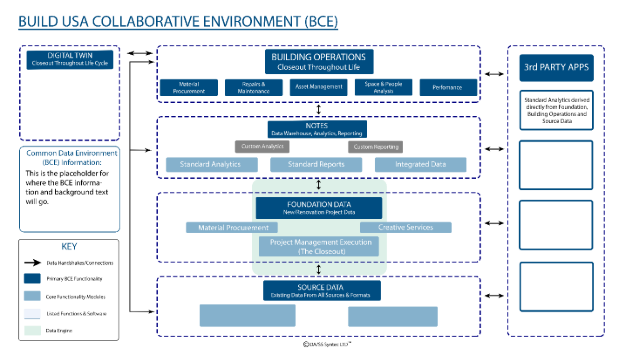

Developing the BCE Data Engine
The current focus within BuildUSA has been on developing the Standards, Templates, and Workflows for the Data Engine Component of the BCE — the part that drives how information flows through the system.
To achieve this, the team conducted three key analyses:
- Building Lifecycle Analysis:
How data is created, shared, and analyzed throughout each phase — design, construction, and operations.
- User Analysis:
How data is accessed and used by different stakeholders, ensuring each user group can interact effectively within the system.
- Master Database Architecture Analysis:
How data is structured, secured, and exchanged within the BCE’s database environment.

Clean Data: The Key to BCE Success
For the BCE to operate seamlessly and reach its potential, the integrity of its data is crucial. Templates and standards enforce consistent data structures — protecting critical parameters while maintaining the flexibility that users need for unique project conditions.
The goal is to find the right balance: enough structure to ensure interoperability, but enough freedom to empower creativity and project-specific needs.

Conclusion: Can the BCE Work?
Yes — but success depends on disciplined implementation and a commitment to collaboration.
When properly deployed, the BuildUSA Collaborative Environment creates a unified digital ecosystem that streamlines workflows, improves transparency, and enhances decision-making across the entire building lifecycle.
The result is a smarter, more efficient AECO industry — one that builds better, faster, and with greater long-term value.
Next Up in the Series:
We’ll dive deeper into the Standards, Templates & Workflows that power the BCE — and explore how they connect people, processes, and technology into one collaborative framework.
Photo by Vardan Papikyan on Unsplash